Building Better: Sustainability at Base Structures

Sustainability in the world of construction is no longer a headline but a responsibility to each project we look at. It’s in how we design, engineer and deliver every project, not as an afterthought but as a practical, measurable part of how we operate.
Construction, engineering and materials all carry an environmental cost. So, the question isn’t whether there is impact, it’s what you do about it. Our approach is to reduce what we can control, and the relative environmental cost of a fabric approach can usually mean there are significant carbon savings to be had when it comes to designing with fabric over other more traditional building methods.
A Net Zero Approach
For the past three years, Base Structures has operated at minimal to net zero emissions across Scope 1 and Scope 2 without relying on offsetting. These are the emissions directly tied to how we run our business: energy use, fuel consumption, day-to-day operations. Achieving this without offsetting means we’ve focused on doing things better on a consistent basis, but we know there’s more to be done.
Scope 3 emissions are those tied to our supply chain, materials and the lifecycle of the products we create. In the world of construction these emissions are significantly more complex, and it’s also where the majority of emissions sit in our sector. There are no quick wins here, and no shortcuts, but Base Structures is committed to collaboration, transparency and long-term thinking.
That’s why we have a Carbon Reduction Plan aligned with the UK Government’s Net Zero by 2050 commitment, and we’re actively working towards reaching net zero ahead of that deadline.
We are taking action some specific areas:
Reducing Consumption
With a fleixlbe working policy, we avoid travel where possible and priotise public transport and online meetings where possible. We also work hard to reduce our water consumption when cleaning materials, changing from full force hoses to sprays.
Collaborating to Reduce Emissions
We’ve designed and developed sustainability audit forms and carbon calculators for products, helping our teams and suppliers reduce Scope 3 emissions.
Engaging our Local Community
We get involved in local community regeneration projects, and actively contribute to schemes in our area such as litter picking. We have also worked with grassroots art organisations and festivals that prioritise reuse and limit waste where possible.
Reducing Waste and Reusing Materials
We actively explore creative options for re-use, from donating old fabric to charities to making covers for benches at music festivals. We operate on a zero waste to landfill basis, and will always work to reduce waste when it comes to end-of-life fabrics.

Designing with Less
One of the most powerful ways to reduce environmental impact is through material reduction. Tensile fabric structures are our core expertise, and using technical fabrics, carbon-intensive materials are only used in isolation.
Compared to traditional construction methods, tensile structures are fundamentally lightweight. They require significantly less material overall, smaller foundations and less intrusive groundwork. This creates a structure that delivers the same functional outcome desired in any project but with a fraction of the embodied carbon.
A Practical Example: Euston Temporary Screens
A clear example of this approach in action is our work at Euston Station.
As part of the project, a multi-storey building had its external wall removed to accommodate future platform works. The requirement was for a temporary, fully waterproof screening solution that was robust and reliable. It also had to be quick to install and deinstall when future work commenced.
Environmental performance was a key consideration for this project and was one of the reasons why a fabric solution and Base Structures was chosen as the key partner for the job. The project team undertook detailed assessments of potential solutions, measuring both material impact and overall carbon footprint – our approach offered a demonstrably lower carbon option.

By using a tensile fabric system, we were able to achieve the required performance using significantly less material than a traditional alternative. The structure was lighter, required less supporting infrastructure and reduced the overall carbon footprint of the solution without compromising durability or effectiveness.
By reducing overall weight, structural requirements and installation impact, the scheme achieved a lower embodied carbon footprint. This demonstrated that it’s not just the materials you choose, but how efficiently you use them that defines true environmental impact. They also don’t compromise on longevity - after three years this solution is still in place which further reduces embodied carbon as they haven’t needed replacing.

“Tensile fabric structures often have far less embodied carbon than buildings built using traditional methods. This means that when we look at everything from raw materials, production, manufacturing, transport, installation, maintenance and end of life, our structures are a very good option for anyone wanting to minimise a construction project’s impact on the environment.”
Milo Fish
HSE Manager, Base Structures
Engineering Efficiency
Every Base Structures project is engineered to do exactly what it needs to, optimising structural efficiency and reducing waste with precision in mind from the outset.
And because many of our structures are temporary or demountable, they can be reused, reconfigured or removed with minimal long-term impact on the site. That flexibility is another key part of reducing lifecycle emissions.
Longevity through Maintenance
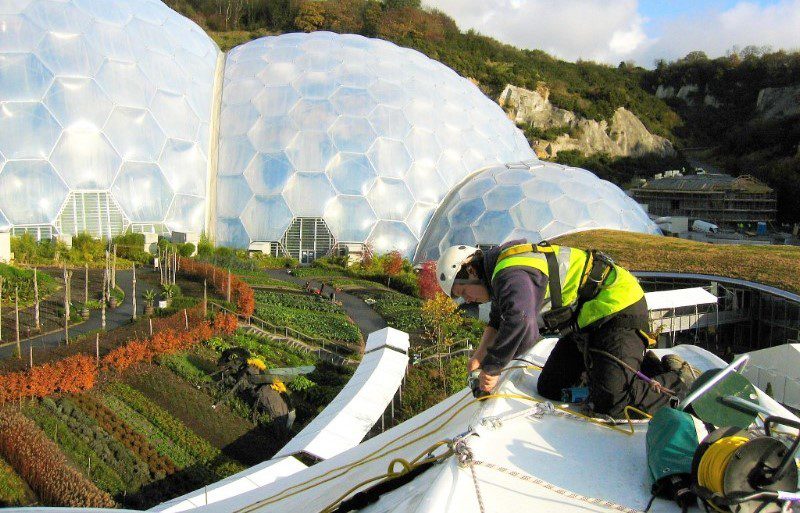
Longevity is one of the most effective and often overlooked ways to reduce environmental impact. By properly maintaining tensile fabric structures, we can significantly extend their lifespan, reduce the need for replacement materials, manufacturing and installation. Regular inspection, careful cleaning and targeted repairs ensure structures continue to perform as intended for years beyond their initial installation. The longer a structure lasts, the lower its overall carbon footprint and through regular cleaning and maintenance, we can protect investment already made in materials, energy and design.
Find out more about our maintenance and replacement services here.
Sustainable Progress
We are making measurable progress at Base Structures and operating with real reductions in our direct emissions, delivering lower-carbon solutions through intelligent design and actively tackling the more complex challenges across our supply chain.
Most importantly, we’re approaching sustainability in the same way we approach every project: with clarity, honesty and collaboration.
If you’re looking for a partner who understands how to balance performance, practicality and environmental responsibility, we’d be glad to talk. Whether it’s a temporary installation, a permanent structure or something altogether more unconventional, we’ll work with you to find the most efficient, considered solution.
mail@basestructures.com
+44 (0) 117 911 5250